

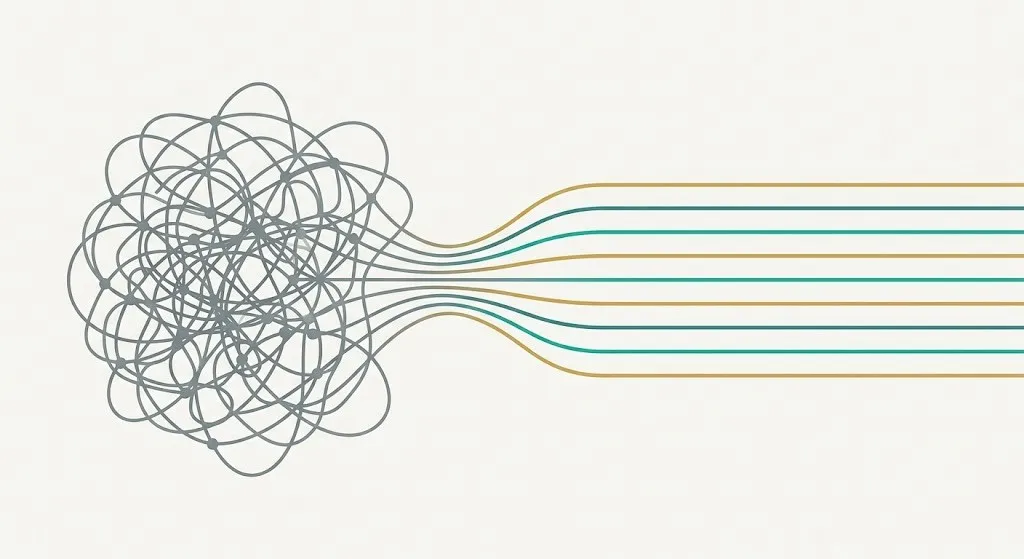
By the time a People Potential programme begins, much of the work has already happened. Behind every session sits a web of scheduling, client requirements, participant information, materials, evaluations, internal handovers, and last-minute changes.
For years, much of this was managed through our internal scheduling system in ClickUp. It worked. But by 2025, the system had grown more complex than it needed to be. So, in September 2025, we began rebuilding it.
The brief for Schedule 2026 was simple: make the system easier to use without losing what mattered. We started with the friction captured through day-to-day use. What was slowing people down? What was duplicated? Which fields and processes were still useful, and which had simply remained over time? The result was a significant clean-up. Custom fields were reduced from 134 to 43, while nine statuses became seven. Information was re-organised into clearer, purpose-specific areas, and 66 automations were introduced to reduce repetitive manual work.
Before anything went live, the changes were tested in a mirrored ClickUp environment. Workflows were checked, usability issues surfaced and adjustments were made before wider implementation. Schedule 2026 launched in December 2025, but the work did not end there. The principle remains simple: Use it ? Capture what is not working ? Review it ? Improve it ? Test it ? Repeat
Most participants will never see this side of a programme. And that is exactly the point. When the system behind the programme works well, attention stays where it belongs: on the learning experience.rogrammes are designed for transformation – not just delivery. When impact isn’t dependent on numbers. And when the trainer shows up like every learner matters.