

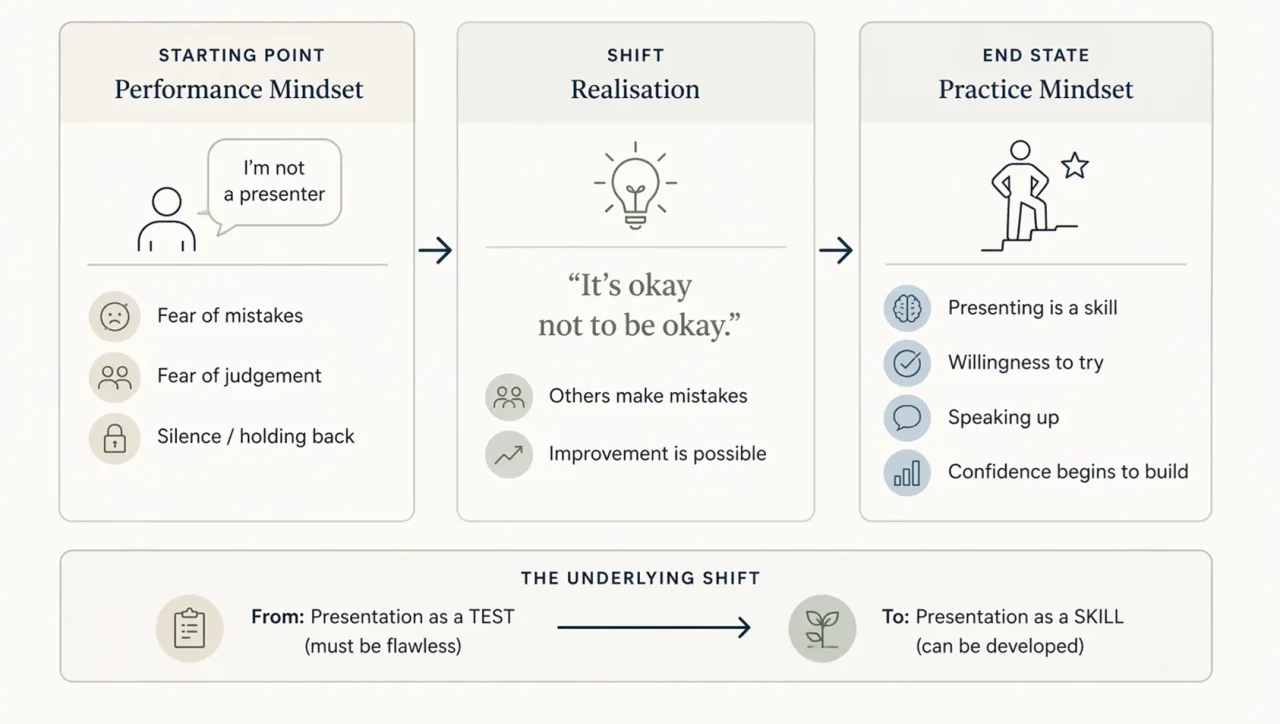
At the start of the two-day Presentations Alive! training, she introduced herself almost apologetically: “I’m from Finance. I don’t usually make presentations.”
What followed wasn’t a lack of ability – it was fear. She wasn’t comfortable expressing herself because it wasn’t routine. She was afraid of making mistakes, afraid of other people’s opinions, and afraid of being judged. Faced with stakes that felt deeply personal, she did what many people do: she chose silence.
During the closing circle at the end of Day 2, her reflection was simple but profound: “It’s okay not to be okay. I’ve noticed that everyone makes mistakes. No one is perfect. In the end, you will improve.”
That sentence represents a fundamental shift from performance to practice – from believing that a presenter must be flawless to realising a presenter must simply be willing. The change wasn’t abstract; she left with an entirely different attitude towards speaking. “Now I’m a bit more confident about speaking up,” she shared.
That moment reminded me of someone I met nearly twenty years ago – also from Finance – who joined a class saying that she didn’t really make presentations but had come to “see what it was about.” By the end, she was the most transformed presenter in the cohort. She didn’t become the loudest; she became visible.
The pattern is consistent: when you stop treating a presentation like a test and start treating it like a skill, confidence stops being a personality trait and becomes something you can build.

Regina Morris
Senior Business Presentations Specialist