

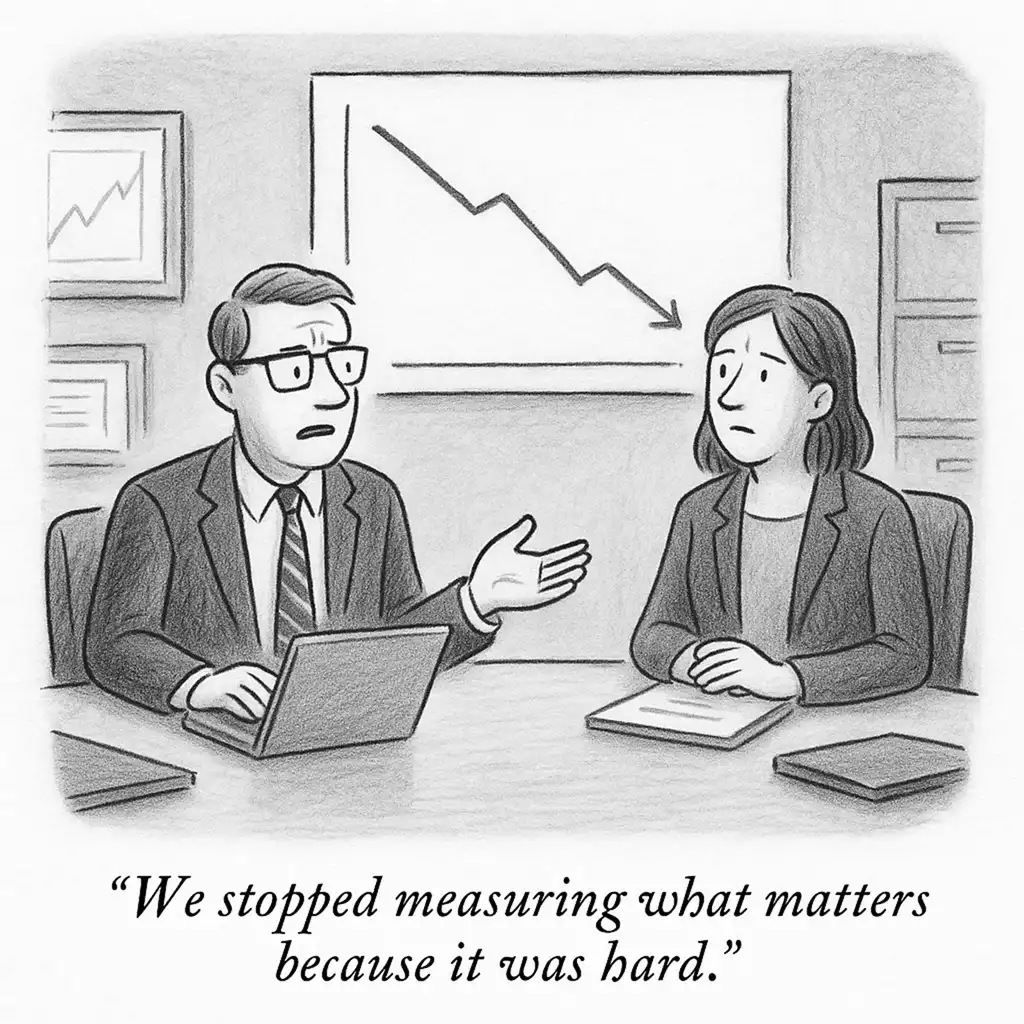
There’s a ritual that is common in many organisations. A team is sent for a two-day workshop. The facilitator is (usually) polished, the slides are pretty, and the tea breaks are satisfying. Everyone signs the attendance sheet, and HR records: “Training Days Attended.” With that, the box is ticked. KPI met. Budget justified. And the assumption, unspoken but persistent, is that learning has occurred. But has it?
Anyone in learning and development (L&D) knows this moment too well. It’s where the measurement becomes the end goal. “Training Days Attended” has, in many organisations, become the standard for tracking employee development. But it’s a dangerously shallow proxy – one that risks measuring everything except learning. Which is why we were happily surprised when a client recently said that they have decided to stop measuring training days per employee.
The Metric Drift: From Proxy to Illusion
Economist Charles Goodhart once said, “When a measure becomes a target, it ceases to be a good measure.” This is now known as Goodhart’s Law. Nowhere is this more evident than in corporate L&D. “Training Days Attended” may have started as a useful indicator – a sign that a company was investing in its people. But over time, it has become the goal itself. The number has become the narrative. So what, one may ask?
To understand the limitation of such thinking, consider what gets lost in this measurement:
- The employee who attends but checks emails throughout.
- The one who nods along and forgets everything by Monday.
- The one who signs up just to meet a KPI.
- The employee who mops the floor at home while playing an online video from an LMS provider.
Meanwhile, an informal coaching moment that reshapes a leader’s approach is uncounted. Or a quiet reflection that leads to a change in decision-making remains invisible. This is the cost of easy metrics. They reward the visible and neglect the valuable.
Learning Is Not a Calendar Entry
Real learning is difficult to pin down. It is subtle, emergent, and often inconvenient. It happens in friction – with work, co-workers and bosses. It happens in quiet reflection. It happens with experimentation. And it happens when mistakes show the limits of our knowledge and competence. In short, it is less about time spent and more about change made. But “change made” is messy and hard to measure.
Our systems prefer certainty. So, we measure what we can: hours logged, sessions attended, certificates issued. These are tidy and trackable. They were once created to show we were serious about development – like the principle from the days of the Quality movement that’s attributed to Peter Drucker, “What gets measured gets done.”
CCL’s 70:20:10 Model — Still Relevant, But Evolving
After Drucker, Morgan McCall and colleagues from the Centre for Creative Leadership developed the 70:20:10 model which claims that that 70% of learning comes from experience, 20% from others, and just 10% from formal training. It’s not the most scientific of models, but it remains a useful rule-of-thumb. Yet most organisations still track only that 10%.
Removing “Training Days” from KPIs actually reflects a deeper alignment with this model:
- It de-emphasises formal learning in favour of real work.
- It encourages peer learning and coaching.
- It repositions learning as something ongoing, not event-based.
The model may not be scientific, but it plays an important function: It reminds us if we only measure the easiest-to-count forms of development, we neglect the most powerful ones.
What New Metrics Are Emerging?
Forward-looking companies are embracing alternative metrics that get closer to the heart of learning. Among them:
1. Competency Validation: Can the employee demonstrate a specific skill in a defined scenario?
2. Learning Agility: How quickly does someone adapt? Do they learn from feedback and experience?
3. Workplace Application: What behaviours have changed since the learning intervention?
4. Business Impact: Have error rates dropped? Is customer satisfaction rising? Both of these can now be routinely quantified. Less quantifiable is the measure: Are cross-functional teams collaborating more effectively?
5. Narrative Feedback: What do employees say about the relevance of the learning? This can be captured immediately after a programme. Are they inspired to continue learning? And are what the Net Promoter Score calls ‘promoters’ – employees who encourage colleagues to sign up for a programme? If your training providers don’t measure NPS scores, request them to do so.
6. Digital Analytics: In today’s digital platforms, we can include metrics like post-training reinforcement, using prompts to capture quantitative and qualitative data that AI can easily measure.
Pitfalls to Watch For:
The move away from ‘Training Days Attended’ is not without its challenges. Here are a few pitfalls to look out for.
- New behaviours take time. And they have to cross a ‘line of visibility’ before they are readily noticeable.
- Without formal metrics, learning may become invisible to the organisation. More than that, if an organisation does not already have a culture of learning, managers can easily slip back to wanting immediate results (often driven by quarterly KPIs), thus neglecting to invest in learning and development
- Organisations that don’t have a high-trust, growth-oriented culture run the risk of losing its competitive edge
Making the Shift: From Metric to Meaning
If you’re an HR or L&D leader considering this transition, here are several initiatives that you might find useful:
1. Align learning with business strategy: Don’t start with what to measure. Start with what matters.
2. Train the managers: A culture of learning is only possible when leaders model curiosity, coaching, and reflection.
3. Empower employees: Create systems that support self-directed learning – then get out of the way.
4. Use mixed methods: Combine hard data (analytics, assessments) with human insight (stories, feedback).
5. Recalibrate regularly: There is no perfect dashboard. Review, refine, and stay curious.
Letting Go of the Illusion
“Training Days Attended” will always be tempting. It’s easy to track. It satisfies auditors. It looks good in reports. But if we want to build organisations where learning is real, we have to let go of the illusion that presence equals progress.
The future of L&D won’t be defined by timesheets. It will be defined by the courage to measure what matters.

Terry Netto
CEO – People Potential